
Written By
Written By
The American Bowl kicks off tomorrow night, but it was not the first all-star game to have that name.
Written By
Written By

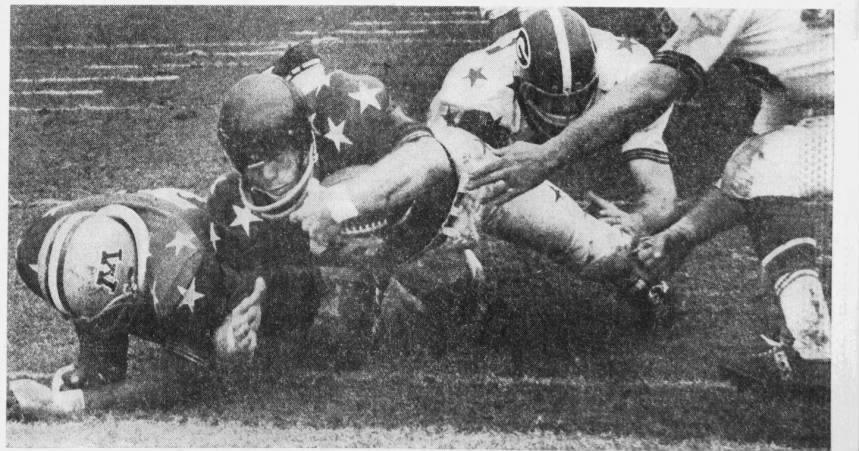
The American Bowl in Lakeland, Florida kicks off for the first time on Thursday night, giving scores of college seniors one last chance to impress pro scouts before the NFL Combine and their pro days. While the American Bowl is a new addition to this year's crowded all-star landscape, it is not the first college football all-star game to bear the name, or even the first one in Florida.
The original American Bowl may not have survived long enough to etch its name alongside the likes of the Senior and East-West Shrine Bowls, but it survived long enough to pave the way for postseason football in Tampa.
The American Bowl's first game took place in January 1969, spearheaded by the Lions' Club of Tampa. The all-star game was a consolation to Tampa's multiple efforts to land an NCAA-sanctioned bowl game. The year before the American Bowl announced its launch, Tampa lost its bid to host a bowl game to Atlanta, who began the Peach Bowl that December.
A syndicator aired the inaugural American Bowl to stations in nearly every major market across the United States, a practice that lasted throughout the bowl's lifetime. Unfortunately, the bowl had poor attendance in its first year, with around 16,000 fans attending due to poor weather.
The bowl faced a lawsuit after its second edition that would set the tone for its lifespan. The Tampa Tribune lamented the death of the American Bowl after the 1970 edition after director Ron Gorton faced a $1.5 million lawsuit over unpaid debts in the first two editions of the game. Gorton had quit as director before receiving the lawsuits, claiming to have lost around $20,000 to $25,000 in personal funds from operating the game.
Against all odds, Robert F. Dudley's CYD Sales Development Company paid off the American Bowl's outstanding debts in exchange for the television rights to the 1971 edition. In all, Dudley paid $50,000 in debt, equivalent to $411,236.04 when adjusted to today's inflation.
Despite Dudley's heroic efforts, the financial struggles remained. Attendance remained low, with 14,000 fans attending the 1977 editions, twenty percent of Tampa Stadium's capacity. The Tampa Tribune reported the bowl owed $40,000 in debt after the 1974 game. Another financial scandal surfaced after the 1977 game in which the Lions Club of Tampa claimed they did not receive that year's television revenue.
The low television ratings which caused the financial snafu led the American Bowl to rebrand and restructure under new leadership as the Canadian-American Bowl or the Can-Am Bowl for short. The Can-Am Bowl was a novel concept, pitting Canadian players against American stars. Canadians loved the concept, with 14 million tuning in to the first Can-Am Bowl. Nevertheless, the spectacle did not amuse fans much. Only 11,203 fans attended the inaugural Can-Am Bowl.
Unfortunately, the Can-Am Bowl experiment was only novel enough to buy the game one more year. The 1979 Can-Am Bowl drew just 11,003 fans to 70,000-seat Tampa Stadium and sold its TV rights to just 80 out of the 100 stations needed to make a profit. Although Can-Am Bowl organizers flirted with the idea of moving the game to Edmonton or Montreal's Olympic Stadium, the Can-Am Bowl eventually ceased operations for good in September 1979, ending the American Bowl's lineage for good.
The first American Bowl is just a forgotten all-star game to many. However, it provided a proof of concept for postseason football in Tampa. One could reasonably argue that the American Bowl's longevity may have attracted the Hall of Fame Bowl when it moved from Birmingham to eventually become the Reliaquest Bowl. This version of the American Bowl hopes to transcend the failures of its predecessor, but for over a decade, the American Bowl sowed the seeds for one of college football's most recognizable bowl games.