

Written By
Written By
It is my genuine belief that College Football is the greatest sport on Earth, and if you are reading this article right now, then chances are you at least have that similar resentment that I do.
That being said, the coaching carousel that was just undertaken has exposed something that the diehard fans knew about for multiple years, but the more agnostic fans are catching up to here in 2025: The College Football Calendar is completely out of whack, and it desperately needs reform.
Yet while it is clearly understood that there is a problem with the calendar, we are still far from having a complete consensus in terms of how to fix said problem. So today, that's what I wish to try and accomplish: to not only fix the calendar as it currently stands but to also fix some of the larger issues that our sport currently faces as we embark deeper into the NIL Era.
What This Plan Proposes: A complete restructuring of college football's conferences, calendar, playoff system, and player movement rules—all designed to restore regionality, maintain traditions, and create a more balanced competitive landscape.
Will some aspects of what I will suggest be more realistic than others? Probably. However, if we ever get into a position where College Football has the centralized leadership that it needs, a commissioner of sorts? This would be how I would fix the calendar and the sport in general for years to come.
One of the first things that I would fix as the future commissioner of College Football would be how our conferences are currently formatted. The Mega-Conferences that we currently have—whether it's the Big 12 and SEC with the 16 teams that each Athletic Conference currently has, or the ACC with its 17-team entity, or even the Big Ten with 18 (!!!) teams in a single conference—all have in common is that they are all definitively too large to effectively manage.
Not only does the size of these conferences create significant disparities of Strength of Schedule within each individual conference, but it also makes tiebreakers become that much more of a nightmare if they become necessary. Perfect examples can be found in both the ACC and the Mountain West during this season alone when the Mountain West Conference had to resort to computer metrics in order to figure out who would play in the conference championship game and then the ACC had a team that went 7-5 over the course of the Regular Season play for a Power Conference Title! All of this happened because again, the conferences are too big which makes it easier to avoid certain teams in the regular season.
So, in order to provide relief to the majority of the issues that we face within the actual season itself, we need to do a better job of balancing the conferences. That should be the Number 1 Priority before any discussions are had on changes to the Regular Season Format as well as the Playoff Format (which I will address later in this article).
Now before I jump into what the conferences should look like, I do want to address a couple of caveats on the front end. First, these conferences should do a better job of embracing the overall regionality of College Football which was/is what makes this sport special. However, in addition to that we need to make sure that the conferences are of a reasonable size because how the new conferences are formatted will help pave the way for how the Regular Season Schedule is handled on a year-to-year basis as well as the College Football Playoff.
With that out of the way, this is how I would organize the conferences as the theoretical commissioner of College Football:
ACC: Clemson, Duke, Florida State, Georgia Tech, James Madison, Maryland, Memphis, Miami (FL), North Carolina, NC State, Virginia, Wake Forest
Big Ten: Illinois, Indiana, Iowa, Michigan State, Michigan, Minnesota, Northwestern, Notre Dame, Ohio State, Penn State, Purdue, Wisconsin
Big 12: Baylor, Iowa State, Kansas, Kansas State, Missouri, Nebraska, Oklahoma, Oklahoma State, TCU, Texas, Texas A&M, Texas Tech
SEC: Alabama, Arkansas, Auburn, Florida, Georgia, Kentucky, LSU, Mississippi State, Ole Miss, South Carolina, Tennessee, Vanderbilt
Pac-12: Arizona, Arizona State, BYU, Cal, Colorado, Oregon, Oregon State, Stanford, UCLA, USC, Washington, Washington State, Utah
American: Army, East Carolina, FAU, Houston, Navy, North Texas, Rice, SMU, UAB, UCF, UTSA, Tulane, Tulsa
Big East: Boston College, Cincinnati, Louisville, Pitt, Rutgers, Syracuse, Temple, UConn, UMass, USF, Virginia Tech, West Virginia
Conference USA: Charlotte, Delaware, FIU, Jacksonville State, Kennesaw State, Liberty, Louisiana Tech, MTSU, Missouri State, Sam Houston, UTEP, Western Kentucky
MAC: Akron, Ball State, Bowling Green, Buffalo, Central Michigan, Eastern Michigan, Kent State, Miami (OH), Northern Illinois, Ohio, Toledo, Western Michigan
Mountain West: Air Force, Boise State, Colorado State, Fresno State, Hawaii, Nevada, New Mexico, New Mexico State, San Diego State, San Jose State, UNLV, Utah State, Wyoming
Sun Belt: Appalachian State, Arkansas State, Coastal Carolina, Georgia Southern, Georgia State, Louisiana, Marshall, Old Dominion, South Alabama, Southern Miss, Texas State, Troy, ULM
As you can see, what I decided to do is revert back to a mix of what was the best of how conferences were aligned in the 2000s and 2010s with a few exceptions. First, I am getting away from the notion of being a Football Independent and have forced Notre Dame and UConn to join a conference. For UConn, it was pretty straight forward with how every other sport for the Huskies was in the Big East so when it came to Football, it only made sense to add them back into the revived Big East. Notre Dame was more interesting though. While it plays in the ACC for all of its other sports, I decided to put them into the Big Ten since it made more sense from a geographical perspective.
Speaking of the Big East, I have also decided to revive the Big East Conference since 10 conferences is simply not enough to get down to a reasonable size across the board. With the majority of new programs who made the transition from the FCS Ranks propping up on the East Coast? It made more sense to bring an East Coast centered conference back into the fold.
Other changes that I made that were either made because it made sense from a geographical standpoint or from a competition standpoint include:
Finally, in order to avoid confusion: I would make sure that regardless of conference affiliation, tiebreakers would become standard across the board. Therefore, a tie would be broken using the following format regardless of what place the two teams are fighting for:
Tiebreaker 1: Head-To-Head Results
Tiebreaker 2: Record vs. Common Opponents
Tiebreaker 3: Conference Strength of Schedule (Overall Win – Loss)
Tiebreaker 4: National Ranking
In the event that it reaches the 4th Tiebreaker and neither team is ranked within the Top 25, the Ranking Committee will continue to rank teams until a winner can be determined.
You will also notice that the tiebreakers don't just determine who would win the conference but also for any other conference position as well. That is because a team's ending position within the conference will be used to help determine a team's non-conference schedule.
So how would the Regular Season work is that I would have a heavy emphasis on playing the teams within your conference as well as honoring any non-conference rivalries because that maximizes the feeling of regionality in the sport as well as maintaining the traditions that we have in College Football.
This means that while the 12-Game Regular Season schedule would be maintained, every team's schedule would contain 10 conference games regardless of which conference a team resides in. The other 2 games of the regular season would be non-conference related based upon the rivalries that exist outside of a current team's conference as well as where a team finished within its own conference during the previous season. The only exception to the 12-Game Rule would be for Army and Navy in order to preserve the timing of that football game.
For example, take the Cincinnati Bearcats. Let's say that the Bearcats finished 4th place in the Big East during the previous season:
The first non-conference game would be Miami (OH) since it is a rivalry game but the other non-conference matchup would pit Cincinnati against a 4th place team from a different conference which would be selected at random and would be take place either at home or away depending on where the Miami Game would be taking place.
Translation: FBS Teams will no longer have access to playing against an FCS Opponent during the Regular Season and neutral site games would be a thing of the past unless it's a very notable exception such as the Red River Rivalry.
As for the rest of the Regular Season Format, that would actually remain somewhat similar to what it is now in the sense of starting on the 2nd to last Saturday in August. However, instead of a Week 0 where only a small handful of teams would play, that would be the official start of the Regular Season which means if we applied it to the 2025 Calendar? The Regular Season would run from August 23rd through November 22nd.
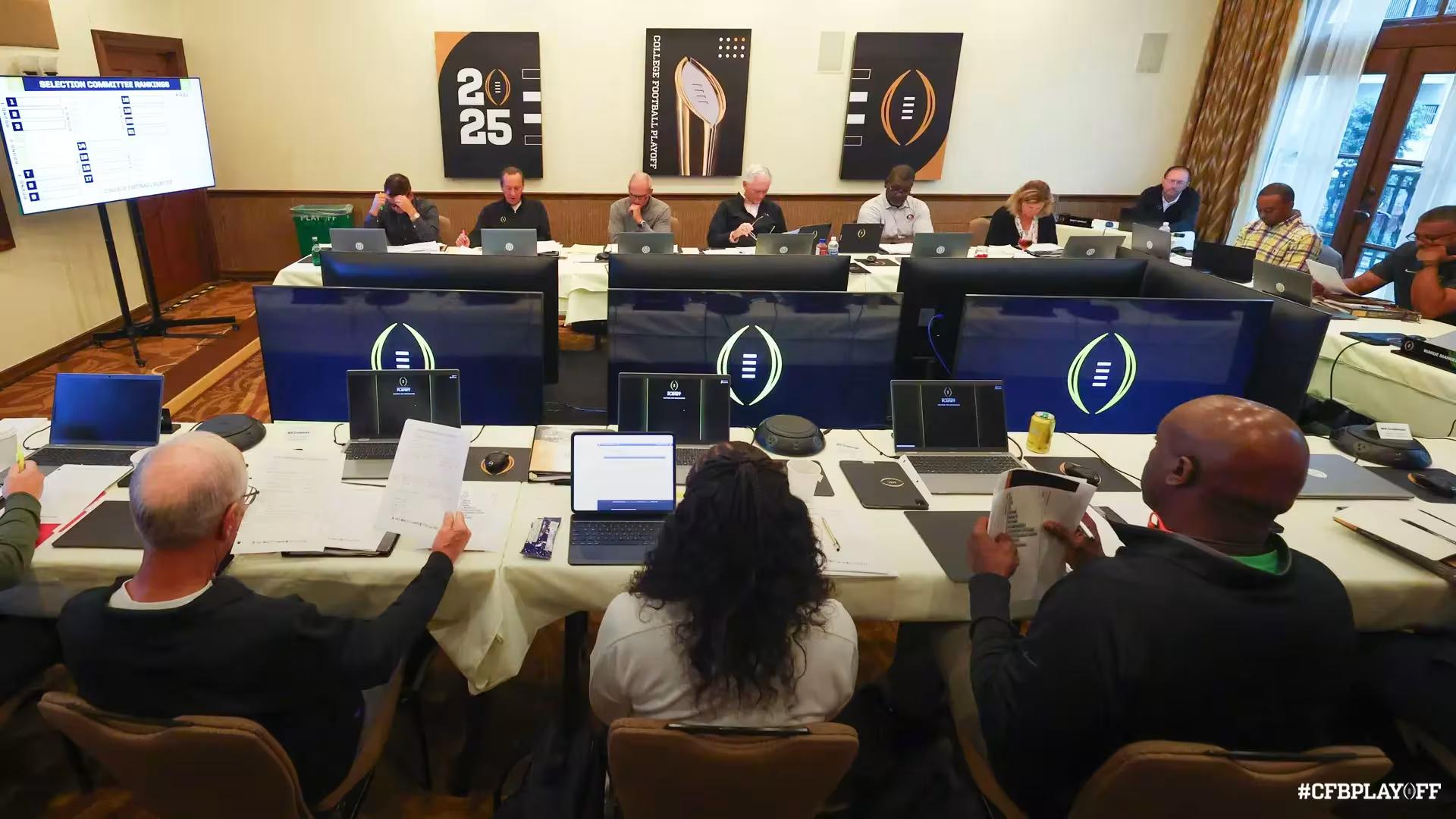
Finally, how teams are ranked in the Pre-Season and throughout the Regular Season would be handled by one centralized ranking committee. The Ranking Committee would consist of 12 people who have in-depth knowledge of the sport and is currently not tied to any athletic department. It would also ensure that at least one person that covers each conference is included on the ranking committee plus one person with notable knowledge on the national level (Think Josh Pate for example). These rankings will be released once a week starting at seven days prior to the start of the season.
So we made it through the Regular Season, its time to now figure out what teams will be involved in terms of competing for the national championship. Now candidly, I actually have no problem with what the current CFP Format is with the 12-Team Playoff and the Top 5 Conference Champions automatically receiving an Auto Bid. However, running a multi-team Playoff to determine a national champion and maintain the current traditions of Bowl Season is no longer feasible. Therefore, we need to reimagine how the Playoff would work as well as how the Bowl Season would work moving forward (I'll talk more about Bowl Season specifically later).
With the conferences that we have in this article would be much more balanced than our current reality? I would adopt the FCS Playoff Model to determine our national champion. For those of you who are not familiar with the FCS Playoff Model, it is a 24 Team Playoff that guarantees every conference champion an opportunity to compete for the national championship. So how would this work in the confines of FBS Football?
11 Conference Champions - Represent the best team out of the ACC, Big Ten, Big 12, SEC, Pac-12, American, Big East, C-USA, MAC, Mountain West, and Sun Belt
13 At-Large Teams – Teams that did not win their conference but are the highest ranked non-conference champions
Those 24 Teams that would be pulled from Conference Champions and other At-Large Spots would be ranked by the same centralized ranking committee responsible by pushing out the Top 25 over the course of the Regular Season and would be straight-seeding based without considerations to whether it would match two teams from the same conference or travel logistics.
Once the Playoff Teams have been determined, the other major aspect that needs to be discussed is when the games should be played. As of right now, our national championship game is decided on a random Monday Night with multiple Playoff Games occurring in the middle of the week. Now, I would make sure for every week of Playoff Games would be staggered on Friday and Saturday if it was an early Playoff Round as well as consolidate the Quarterfinal, Semifinal, and National Championship Game on Saturday only. Within the first two rounds of the Playoff, those would occur on the home field of the higher seeded team while the Quarterfinals through our National Championship Game would be played on the traditional NY6 Bowl Sites and a TBD National Championship Site that would be randomly selected every year.
However, before diving deep into the new look Playoffs, one question remains. That major question is what to do with the Army-Navy Game? And in the interest of maintaining traditions while also starting the Playoff in the timely matter as well, I wanted to move the Army-Navy Game's position in the College Football Season as little as possible. Which is why I came up the following battle rhythm using the current 2025 Calendar as a baseline:
November 22nd: Regular Season would End
November 23rd: Selection Day for the CFB Playoff (Sunday following end of Regular Season)
November 29th: Army-Navy Game would be played (Would not count towards Regular Season Record – Also would be played the Saturday after Regular Season ends)
December 5th-6th: First Round of Playoffs (Home Campus Games)
December 12th-13th: Second Round of Playoffs (Also Home Campus Games)
December 20th: CFB Playoff Quarterfinals
December 27th: CFB Playoff Semifinals
January 3rd, 2026: CFB Playoff National Championship Game
One of the other major issues that we have in the College Football Calendar right now is the timing in which Coaches and Players are essentially forced into a position between finishing the current season out with their current team and either fielding offers for the next career step or already proceed with the prep of putting together a staff on top of the numerous other tasks required when accepting a new coaching job at a different school.
A perfect example of this is Lane Kiffin, who had to make the choice between staying at Ole Miss and finishing the current season out with his current team whom is actively competing for a national championship or accepting the LSU job and starting the prep over in Baton Rouge in order to be successful at his next coaching stint. If this were to ever happen in the NFL, that would be labeled as complete insanity. Therefore, we have to put rules in place that are in the best interest of the Players and Coaches so that there can be an orderly process in place where people don't have to decide whether to finish their current season with their current team or opt-out early.
What that one general rule would be implanting a specific time in which players and coaches can be contacted in specifics to new coaching opportunities as well as new playing opportunities elsewhere for the Players.
For Coaches: They can not be contacted for a new coaching position until after the current team that the coach is employed with completes its current football season.
For Players: They are not allowed to be contacted by a different school in regards to potential roster opportunities until after the player has already decided that they wanted to opt into entering the transfer portal.
What this will do is create less chaos for both the coaches and the players who can now focus on the task at hand. However, rules are no good if the enforcement mechanism is also no good as well.
Therefore, the NCAA would not be involved in the running of College Football and instead be centralized under a single CFB Commissioner. As for if a coach or player was formally contacted prior to the end of that team's season? The offending team would be made ineligible for the Playoffs the following season.
As of right now, the Transfer Portal currently resides in the middle of not only Bowl Season but also runs in the middle of the current Playoff Entity that decides who wins the National Championship which again not only is absolutely insane but also puts coaches and players in a bind with potentially splitting focus on preparing to grind for a national championship and preparing for the next opportunity.
Therefore, as the hypothetical CFB Commissioner, we are going to change that right away. That's why I would move the start of the Transfer Portal to one week after the national championship game and it would run over the remainder of the month of January. This would still give Players about three weeks to decide whether to enter the transfer portal or not while also simultaneously having split focus during the post-season.
Another aspect of the Transfer Portal that would be adjusted is placing a limit in which players can enter the transfer portal during their collegiate career. This is because while I am fully supportive of player movement as well as the players getting paid, having someone transfer to 7 different schools over the span of a college career (Looking at you T.J Findlay) has gotten completely out of hand.
However, I do want to recognize that 17-18 years old making arguably the biggest decision of their life for many of these young people are going to sometimes make a decision that might be viewed with some regret later on. This is why Players should still get the initial opportunity to transfer without losing out on eligibility for future seasons. However, it should also only happen one time.
If someone would like to transfer more than one time, than that person would need to sit out for a full season unless the player was transferring because:
That way, players will still have an opportunity to transfer if their initial choice didn't turn out to be the right fit and also still allows for players to transfer in certain unique situations but can't abuse the transfer portal throughout their college career.
The other major caveat that I would also add into the Transfer Portal window is the institution of the Transfer Fee. Listen, there's no secret that while Transfer Portal has helped disburse talent across a different number of the Power Conference Programs, what has largely happened is that Group of Five Programs would developed these players who were underrecruited but turn out to be diamonds in the rough, then they would get poached by a Power Conference Program largely because those schools would have more NIL Funding to work with than the Group of Five Programs.
So while the G5 Programs would put in all of the work in developing these players, the stars at that level largely get poached and now the program that developed them has nothing to show for it on the back end. One way that we can even the playing field is doing the Transfer Fee.
How Transfer Fees Are Calculated
With that being said, we also would need to have a standardized system in place so that there is clear understanding in terms of what each player's transfer fee would be so that it doesn't become an arbitrary guessing game between the losing school and the gaining school that would like to have his services for the upcoming season. Therefore, what would be used at least as an initial baseline is the NIL Valuation that is provided over on On3 which does a really job of at least providing an initial estimate. Then, we also need other guidelines to account for what the player has actually accomplished during the course of his college career.
This would be how I would set up the Transfer Fees for every player that entered the Transfer Portal:
10% Rate would be the baseline for any player that has not achieved any conference or national awards, would also apply to someone who was not named to an All-Conference or All-American Team
15% Rate would be applied to any player that has achieved some type of Conference Award or All-Conference Team
20% Rate would be applied to any player that has achieved some type of national award or All-American Status
Example: D.J Lagway, who's NIL Estimation lies between 1-2 million Dollars but hasn't achieved any End-of-Season awards as of yet in his college career. So, let's shoot the middle and say that On3's NIL Valuation of DJ Lagway was $1.5 Million.
After a player entered the transfer portal, if lets say DJ Lagway wanted to go to LSU, then LSU would be responsible for paying Florida $150K based on his current NIL Valuation and the 10% rate. How that is paid can be negotiated between the two schools.
Transfer Fee Waivers
However, the Transfer Fee will still be waived if the player is transferring either because:
That way, while the trend of players transferring from a generally smaller program to a more renowned program would continue if they became stars at their previous schools, at least it would also provide a semblance of competitive balance that the smaller schools can use as additional NIL Dollars to replenish their rosters effectively.
Finally, while a player needs to enter the Transfer Portal before the end of the Transfer Portal period, that same person does not need to make a final decision on where there next school destination will be before the end of said period as well.
One of the connecting fabrics of college football that was extremely well captured in the College Football Video Games outside of the PS5 generation was the signing of players from the JUCO and High School Ranks. That being said, while Signing Day is still an event that falls on the calendar every year, it also doesn't carry the same significance as it once posed even 5-10 years ago. However, what we can do is reconsolidate when this signing period occurs by designating one single period as the time for High School and JUCO Athletes sign.
This is because of the fact that we have the early signing period for Football Athletes, so that when we get to actual signing day? Almost everyone in the incoming freshman class has already signed. Hence, while consolidating the Signing Period to a single one-month period may not fix everything, I think that it would at least help in recapturing some of the old magic of signing day.
The only four major caveats that I would have in this spot is that:
Now, we get past the Transfer Portal period and we have officially moved past the signing period for HS and JUCO Athletes, we can now move onto the spring months with significantly more certainty. That certainty of course is now coaches can enter spring ball having complete certain on who is going to apart of their football teams aside from the more severe situations.
As for how Spring Camp can be conducted, they'll be allowed to conduct Spring Practices from the 1st day of March and can run through the end of the spring semester at each institution.
However, the biggest change that I would make to this part of the College Football Calendar is something that I alluded to earlier but am ready to discuss in full detail now… Bowl Season in the Spring!
Listen, we are in an era of college football where the non-Playoff Bowl Games simply do not have the same weight as it had even a decade ago. Therefore, to keep the magic of bowl season alive? We need to do what is in the best interest of Bowl Season and move it to a different time of the year that does not directly compete with the College Football Playoff.
That is why I suggest moving Bowl Season from its current time frame over to Spring where it can be conducted anywhere from the start of March until the end of the Spring Semester for each individual school. We already have a precursor to what the Spring Bowl Season can become with all of the Spring Games that are put on display as inter-squad scrimmages across various campuses. Well, what if instead of having inter-squad scrimmages in the spring and call it a day, you instead have two actual teams go up against each?
That precisely can be what the Bowl Season can serve, an opportunity for the coaching staff to see how the roster can initially look like heading into a new season as well as provide a better sneak peak for the fans that support these programs!
But while Bowl Season would compose of teams that meet the 6-win threshold during the course of the previous regular season, that doesn't mean that other teams that did not meet that threshold can't participate in the new Spring Games Format. For those teams that didn't reach 6-wins over the course of the Regular Season? They would also be allowed to have a spring game against other non-Bowl Teams as well as FCS Programs.
Alright so the final step in renovating the College Football Calendar would be to figure out what to do with the Summer Months leading into the new College Football Season. While this time period would serve as the final phase of offseason prep before the Regular Season begins, there would also only be a few things planned during this time period.
First would be the unveiling of the Schedule for the upcoming season. In the past, conferences would roll out their full schedule at different times but since we would centralize the leadership of College Football as the hypothetical commissioner, the schedule reveal for every FBS Team would happen at the same time and can turn it into a TV event as well.
It can work similarly to how FIFA does it group draws where a random team is picked and then that team would have its entire schedule built out for the upcoming season. Because of the number of teams in the FBS, it can be either an All-Day, Multi-Day, or even full week affair depending on how you want to break it out. Now, the biggest priority of building out the schedule would be to ensure Rivalries are maintained regardless of whether or not the matchup resides in the same conference as well as a healthy rotation of playing conference teams at a reasonable rate since my conference alignment still isn't to the point where every team would play each other over the course of every weekend.
So using my beloved Cincinnati Bearcats as an example, this could be what the Bearcats 2026 Schedule could look like if the new conferences and scheduling format were adopted for next season assuming they would have finished in 4th place in the Big East Conference during 2025:
NON-CONFERENCE GAME 1: Miami (OH) – Non-Conference Rivalry Game
NON-CONFERENCE GAME 2: 4th Place American Conference Team (Randomly Selected Non-Conference Game)
BIG EAST GAME 1: Louisville (Rival – Would Play Every Year)
BIG EAST GAME 2: Pitt (Rival – Would Play Every Year)
BIG EAST GAME 3: West Virginia (Rival – Would Play Every Year)
BIG EAST GAME 4: UConn (Conference Rotation Game)
BIG EAST GAME 5: Rutgers (Conference Rotation Game)
BIG EAST GAME 6: UMass (Conference Rotation Game)
BIG EAST GAME 7: Boston College (Conference Rotation Game)
BIG EAST GAME 8: Virginia Tech (Conference Rotation Game)
BIG EAST GAME 9: Temple (Conference Rotation Game)
BIG EAST GAME 10: USF (Conference Rotation Game)
Since Syracuse would be the only team from the conference that Cincinnati wouldn't play, they would automatically play the Orange during the 2027 Season with each team receiving 6 Home Games and 6 Away Games (5+5 within the conference and 1+1 outside of conference play). This process would repeat itself until the schedule of every FBS Program is completely built out. All of this would be happening sometime early in the month of June.
Up next would be your conference media days which would operate somewhat similarly to what they would operate now but make sure that it's somewhat around the same time so would shoot for Mid-Late June as the time period to have the conference media days.
Finally, I would opt for Summer/Fall Camps being allowed to start up any time after July 1st, but the exact start time would be discretionary on each individual coaching staff as long as the Summer Camps don't start before July 1st.
So there you have it, my full manifesto in terms of not only what I would change about the College Football Calendar but would also change about our sport as of right now. Hopefully, meaningful changes can be made that not only allow for the sport to flow as smoothly as possible while maintaining the connective tissue that allows fans to feel more connected to their favorite college football teams.
While the sport is still in a solid spot now in terms of fan interest, I think that the next 5-10 years are really going to serve as how leadership handles the current fork in the road. Hopefully, that leadership begins to think about what is in the best interest of the sport both in the short term and in the long term instead of this continued trend of what is best for generating the most money possible in the right now.